
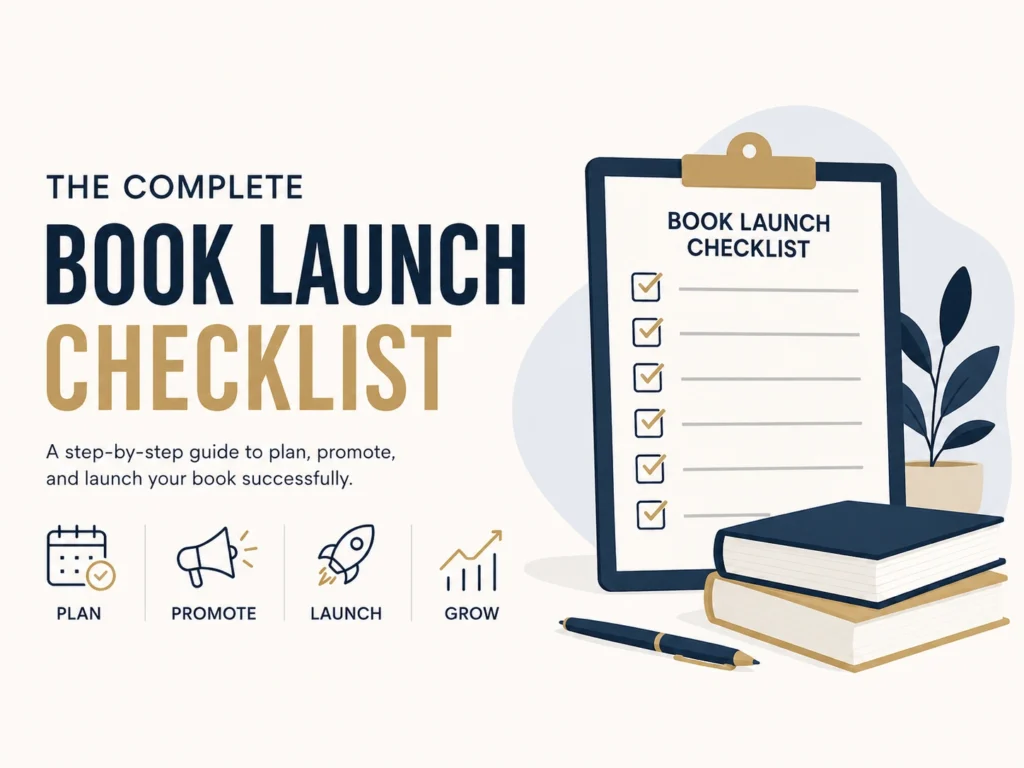
Launching a book involves much more than choosing a release date and posting an announcement online. A successful launch requires preparation, coordination, and consistent book promotion before, during, and after publication.
This book launch checklist is designed to help authors organize the process step by step. Whether you are preparing your first release or planning your next title, the goal is to create enough awareness, interest, and momentum so readers know your book exists and understand why it may be worth reading.
Why You Need a Book Launch Checklist
A book launch includes many moving parts.
Authors may need to manage:
- Editing
- Cover design
- Formatting
- Publishing accounts
- Metadata
- Retailer listings
- Author branding
- Website updates
- Email campaigns
- Social media content
- Reviews
- Media outreach
- Events
- Advertising
Without a clear plan, important tasks can easily be forgotten or completed too late.
A structured book launch checklist gives you a timeline and helps ensure that your publishing and marketing activities support one another.
1. Finalize Your Manuscript
Before you begin serious promotion, your manuscript should be close to completion.
Review:
- Developmental edits
- Copyediting
- Proofreading
- Formatting
- Chapter structure
- Copyright information
- Acknowledgments
- Author biography
- Front and back matter
Avoid promoting a release date too early if the manuscript is still undergoing major revisions.
Delays can affect retailer listings, printing schedules, advance review copies, and marketing plans.
2. Define Your Ideal Reader
Before you launch a book, identify the audience you want to reach.
Think about:
- Age
- Interests
- Genre preferences
- Reading habits
- Common problems or goals
- Favorite authors
- Social media platforms
- Preferred book formats
A business book may target professionals and entrepreneurs, while a romance novel may focus on genre readers and online reading communities.
The clearer your audience is, the easier it becomes to choose the right marketing channels.
3. Create a Strong Book Positioning Statement
Your positioning statement explains what makes the book relevant and why a specific reader should care.
Try to answer:
- Who is the book for?
- What problem does it solve or experience does it provide?
- What makes it different?
- Why should someone read it?
This message can guide your:
- Book description
- Website copy
- Social posts
- Advertisements
- Email campaigns
- Media pitches
Strong positioning helps create consistency across the entire launch.
4. Finalize the Book Title and Subtitle
Your title should be clear, memorable, and appropriate for the genre.
For nonfiction, a subtitle can explain the benefit or topic more clearly.
Review whether the title works well on:
- The cover
- Retailer listings
- Social media graphics
- Search results
- Your author website
Avoid changing the title late in the process unless necessary, because it may require updates across multiple platforms.
5. Complete the Book Cover Design
Your cover often creates the first impression of the book.
A professional cover should:
- Match the genre
- Be readable at thumbnail size
- Use clear typography
- Include a strong visual hierarchy
- Display the title and author name clearly
You may also need different versions for:
- Paperback
- Hardcover
- eBook
- Audiobook
Test how the cover appears on both desktop and mobile retailer pages.
6. Prepare the Book Description
Your book description should help potential readers quickly understand why the book matters.
A strong description usually includes:
- An attention-grabbing opening
- The central idea, promise, or conflict
- The intended audience
- The value or experience readers can expect
- A clear reason to continue
For fiction, focus on story, conflict, and emotional stakes.
For nonfiction, focus on the reader’s problem, desired outcome, and key benefits.
7. Prepare Your Publishing Metadata
Accurate metadata helps retailers, libraries, and readers understand your book.
Prepare:
- Book title
- Subtitle
- Author name
- Book description
- Categories
- Keywords
- ISBN details
- Publication date
- Language
- Format
- Pricing
- Publisher or imprint information
Review all metadata carefully before publication.
Small inconsistencies can create confusion across distribution platforms.
8. Decide Which Formats to Publish
Your book can potentially be released in multiple formats.
Common options include:
- Paperback
- Hardcover
- eBook
- Audiobook
- Large-print edition
You do not necessarily need to release every format on the same day.
However, decide early enough so production and promotional materials can be planned properly.
9. Set a Realistic Book Launch Date
Choose a publication date that gives you enough time to prepare.
Avoid choosing a date simply because it sounds appealing.
Consider:
- Editing deadlines
- Cover completion
- Proof copies
- Distribution approval
- Website development
- Advance reader preparation
- Media outreach
- Holidays
- Events
- Your personal schedule
A rushed release can make even a strong book launch more difficult to manage.
10. Build or Update Your Author Website
Your website should act as the central hub for the book launch.
Create a dedicated book page that includes:
- Book cover
- Description
- Purchase links
- Formats
- Reviews
- Sample chapter
- Audiobook preview if available
- Author information
- Newsletter registration
Make sure the website works properly on mobile devices.
Your social posts, emails, interviews, and advertisements should have a clear destination where readers can learn more.
11. Create a Book Landing Page
A dedicated landing page can support a specific launch campaign.
It may include:
- The book title
- Cover
- Short description
- Key benefits
- Reviews
- Buy buttons
- Sample chapter
- Email form
- Preorder information
Keep the page focused.
Avoid distracting visitors with too many unrelated links.
12. Build Your Email List Before Launch
Email gives authors a direct way to communicate with interested readers.
Begin building your list before release.
Possible incentives include:
- Sample chapter
- Bonus material
- Printable guide
- Short story
- Discussion questions
- Early access
- Behind-the-scenes updates
Your email subscribers can become some of your most important launch supporters.
13. Prepare Your Launch Email Sequence
Do not wait until launch day to write your emails.
Prepare them in advance.
A simple launch sequence could include:
Email 1: Announcement
Introduce the book and explain why you wrote it.
Email 2: Behind the Scenes
Share part of the writing or publishing journey.
Email 3: Preview
Offer a sample chapter, excerpt, or key lesson.
Email 4: Launch Day
Announce that the book is officially available.
Email 5: Reminder
Share reviews, reader reactions, or additional reasons to explore the book.
Keep each message useful and avoid sending only sales-focused emails.
14. Create a Social Media Content Calendar
Your book promotion should begin before publication.
Prepare social content for:
- Cover reveal
- Release date announcement
- Author story
- Book quotes
- Character introductions
- Research insights
- Sample pages
- Behind-the-scenes updates
- Countdown posts
- Launch-day announcement
- Reader reviews
Planning content early reduces the pressure to create everything during launch week.
15. Choose the Right Social Platforms
You do not need to promote your book on every platform.
Choose the channels where your ideal readers are most active.
Depending on the book, you may focus on:
- TikTok
- YouTube
Use each platform according to its strengths.
For example, LinkedIn may work well for business books, while Instagram and TikTok can support highly visual and genre-driven promotion.
16. Prepare Your Advance Reader Team
Advance readers can help generate early awareness and honest feedback.
Potential advance readers may include:
- Newsletter subscribers
- Existing readers
- Book bloggers
- Genre enthusiasts
- Professional contacts
- Book-club members
Give readers enough time to finish the book before launch.
Be clear that reviews should reflect their genuine opinions.
17. Send Advance Review Copies
Advance review copies, often called ARCs, can help authors secure reviews before or around publication.
Provide reviewers with:
- The book
- Release date
- Book summary
- Author biography
- Review links when available
- Contact details
Do not pressure reviewers to provide positive feedback.
The goal is to gather authentic reader responses.
18. Create a Professional Media Kit
A media kit makes it easier for journalists, bloggers, podcast hosts, and event organizers to feature you.
Include:
- Book cover
- Author photo
- Short biography
- Long biography
- Book summary
- Publication information
- Interview topics
- Sample questions
- Contact information
- Website links
Make the media kit easy to access from your author website.
19. Start Podcast and Media Outreach
Begin outreach before the release date.
Look for:
- Podcasts
- Blogs
- Local media
- Online publications
- Newsletters
- YouTube channels
- Book communities
Personalize each pitch.
Explain why your story, expertise, or book topic would be valuable to their audience rather than simply asking them to promote your book.
20. Contact Libraries and Bookstores
Local promotion can create strong opportunities.
Reach out to:
- Independent bookstores
- Libraries
- Schools
- Universities
- Book clubs
- Community organizations
Ask about opportunities such as:
- Book signings
- Author talks
- Readings
- Workshops
- Local-author displays
- Book-club discussions
Prepare professional book information before making contact.
21. Plan a Book Launch Event
A launch event can be physical, virtual, or both.
Possible formats include:
- Book signing
- Live reading
- Online Q&A
- Author interview
- Webinar
- Panel discussion
- Book-club event
- Livestream
Promote the event several weeks in advance.
Collect registrations or email addresses where appropriate so you can follow up afterward.
22. Prepare Launch-Day Graphics
Create visual assets before launch day.
You may need:
- Book cover graphics
- Launch announcement
- Quote graphics
- Review graphics
- Story templates
- Countdown graphics
- Website banners
- Email images
Use consistent fonts, colors, and design elements to reinforce your author brand.
23. Review All Retailer Listings
Before launch, confirm that your book listings are accurate.
Check:
- Title
- Subtitle
- Author name
- Cover
- Description
- Categories
- Price
- Formats
- Publication date
- Purchase links
Test the links from your website and social media profiles.
A broken purchase link on launch day can cost valuable traffic.
24. Prepare Your Book Promotion Budget
Not every launch requires a large advertising budget.
Decide in advance how much you can realistically spend on:
- Advertising
- Printing
- Promotional graphics
- Events
- Giveaways
- Website updates
- Publicity
- Shipping
- Audiobook production
Separate required publishing costs from optional promotional spending.
This gives you better control over the total campaign.
25. Test Paid Advertising Carefully
If paid advertising is part of your launch, start small.
Test:
- Different audiences
- Different headlines
- Different graphics
- Different calls to action
Track results such as:
- Clicks
- Landing-page visits
- Email sign-ups
- Purchases
- Cost per result
Avoid increasing the budget until you know which advertisements perform best.
26. Prepare for Launch Week
During launch week, focus on execution rather than creating everything from scratch.
Your launch-week checklist may include:
Publish launch announcement
Send launch email
Update website banner
Check retailer listings
Share purchase links
Respond to comments
Share reviews
Attend scheduled interviews
Host launch event
Monitor website traffic
Track sales and engagement
Keep important links and promotional materials organized in one place.
27. Ask Readers for Honest Reviews
After readers begin receiving the book, invite them to leave honest reviews.
You can remind readers through:
- Social media
- Website
- Book-club discussions
Make the process simple by providing direct links to the relevant review pages.
Avoid offering rewards specifically for positive reviews.
28. Continue Promoting After Launch Day
A book launch does not end after the first week.
Continue your book promotion through:
- Blog content
- Email newsletters
- Social media
- Podcasts
- Events
- Reviews
- Media features
- Seasonal campaigns
- Audiobook launches
Some books build momentum gradually rather than immediately.
Long-term visibility is often more valuable than one short burst of attention.
29. Repurpose Your Launch Content
Do not discard your launch content afterward.
Reuse materials such as:
- Interviews
- Reviews
- Author videos
- Event recordings
- Book excerpts
- Blog articles
- Reader questions
For example, a 30-minute interview can become several short videos, social posts, quotes, and email content.
Content repurposing helps extend the life of your launch.
30. Measure Your Book Launch Results
After the launch, review what worked.
Track:
- Book sales
- Website traffic
- Email sign-ups
- Social engagement
- Review growth
- Event attendance
- Ad performance
- Traffic sources
- Book-page visits
Ask yourself:
- Which platform produced the most interest?
- Which content received the strongest response?
- Which email generated the most clicks?
- Which partnerships delivered useful exposure?
- Which activities were not worth repeating?
These insights will make your next launch stronger.
Your Complete Book Launch Checklist
Before the Launch
Finalize manuscript
Complete editing
Approve cover
Finalize formatting
Prepare metadata
Choose publishing formats
Set publication date
Build book landing page
Update author website
Build email list
Prepare email sequence
Create social media calendar
Recruit advance readers
Send ARCs
Prepare media kit
Begin media outreach
Contact libraries and bookstores
Plan launch event
Prepare promotional graphics
Review retailer listings
During Launch Week
Announce the release
Send launch email
Share purchase links
Publish scheduled content
Host launch event
Attend interviews
Share early reviews
Respond to readers
Monitor performance
After the Launch
Request honest reviews
Continue publishing content
Send follow-up emails
Repurpose interviews
Continue media outreach
Run seasonal promotions
Track sales
Review analytics
Document lessons learned
Plan long-term promotion
Build Momentum Beyond Launch Day
A strong book launch is not about generating attention for one day.
It is about creating a system that introduces the book to readers before release, makes it easy to purchase during launch, and continues generating discovery afterward.
A complete book launch checklist can help authors coordinate publishing, websites, social media, email, reviews, events, and ongoing book promotion instead of treating each activity separately.
At Casa Amorosa, authors can receive support with publishing, author websites, branding, eBooks, audiobooks, SEO, and long-term book marketing strategies.